





Grumpy Group Organiser has his say on too many tourists, tolerating loudspeakers and queuing on a mountain – there’s always something to annoy him.
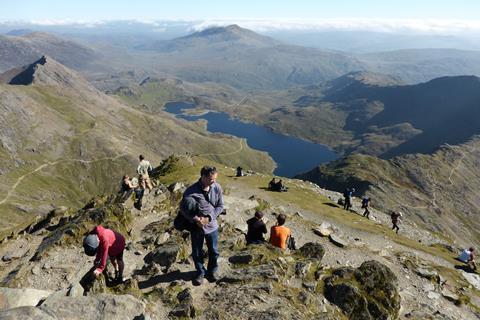
British queuing peaks at Snowdon
I thought I’d seen everything: café queues, toilet queues, even queues for selfies with a fibreglass sheep (don’t ask). But now we’ve reached the summit of British civilisation: queuing on top of a mountain. Reports from the summit of Snowdon, or Yr Wyddfa if we’re being properly Welsh, suggest queues of over an hour to reach the famous summit marker have become a regular feature on busy summer days.
Of course, this has produced an entirely predictable row between those willing to wait and those determined to treat every queue as a challenge to be defeated. Yes, it feels faintly ridiculous; nobody laces up their boots to explore a great wide-open space and pictures a bottleneck.
But the alternative is a chaotic scrum on a narrow summit with people pushing, shoving and waving selfie sticks around. The answer is not complicated. Reach the top, enjoy the view, take your photograph and move on. We don’t need wardens with whistles, velvet ropes, numbered tickets or a Fast Pass system - just a little consideration.
Of course, I did Snowdon the sensible way… I took the train to the top and back.
Is overtourism just bad timing?
Ah yes, overtourism. When people realise that their marketing campaign has worked a little too well and tourist attractions contain too many… tourists. A new study by Emily Dreilich of Voyagers Travel, using data from government tourism bodies and park authorities, warns that visitor patterns are changing rapidly at places including Machu Picchu, Venice and Barcelona.
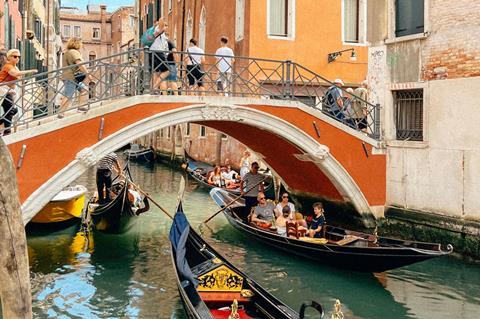
Peru’s famous Machu Picchu saw the fastest visitor growth of any destination in the study. It welcomed 1,508,121 visitors in 2024, a 57.8% jump from 2023, despite operating under a daily entry cap of 4,500 to 5,600 visitors. Not the picture in the poster, is it? How about Venice, which saw 24,951 people paying the day tripper entry fee on the single busiest day of 2025. That is roughly half the city’s entire resident population. But isn’t much of this simply a case of everybody wanting to go to the same place at the same time?
Schools breaking up, bank holidays, summer sunshine and suddenly Venice is packed. What a shock. The irony is that group travellers have often mastered the art of avoiding the crowds. Coaches arrive outside peak periods, itineraries are planned around quieter days and nobody voluntarily queues for hours to visit an attraction.
Maybe overtourism isn’t always about too many visitors. Sometimes it’s just about terrible timing.
The soundtrack nobody asked for
Remember when a phone was something you held to your ear? Simpler times.
These days, every train, café, waiting room and attraction seems to come with an unsolicited soundtrack courtesy of someone else’s mobile. Whether it’s a FaceTime call with Auntie Brenda, a Facebook video or music that sounds like it was recorded inside a biscuit tin, we’re all expected to listen along.

Transport for London knows it’s a problem because its ‘Travel Kind’ campaign encourages passengers to use headphones and be considerate of others. But this behaviour is now so common that experts are debating whether we’ll simply learn to tolerate it. I admire their optimism.
Even Wetherspoons has had enough, banning customers from blasting calls and videos on loudspeaker after complaints that people were being “driven nuts”. Quite right too. Although if founder and chairman Sir Tim Martin is positioning Wetherspoons as an “oasis of tranquillity and contemplation”, society may already have crossed a line from which there is no return.
Got a view or comment? Find all his columns at groupleisureandtravel.com/grumpy and add your thoughts at the bottom.













No comments yet