




With the original Bayeux Tapestry heading to the British Museum this September, Reading Museum is marking a milestone anniversary of Britain’s own full-scale replica of the medieval artwork.
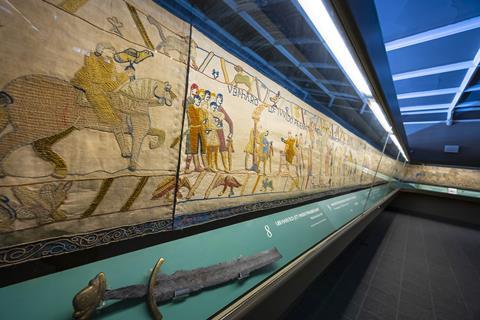
Like the original, the British replica is an intricate embroidery and was completed in 1886 by the Leek Embroidery Society. Led by Elizabeth Wardle, who had the idea to create it after seeing the original and deciding England “should have a copy of its own”, it took 35 women just over a year to hand-stitch the designs based on tracings from photographs in the Victoria & Albert Museum (then the South Kensington Museum).
For ten years following its completion, the tapestry was displayed in Leek and other venues across Britain, and also travelled to Germany and America. It was eventually bought in 1895 by the Mayor of Reading and displayed in Reading Museum.
A specially designed gallery was opened at the museum in 1993 which allowed the 70-metre tapestry to be displayed in its entirety for the first time. The replica is slightly taller than the original as it has an extra blue border at the bottom where the 35 women who made it, recorded their names under each section they sewed.
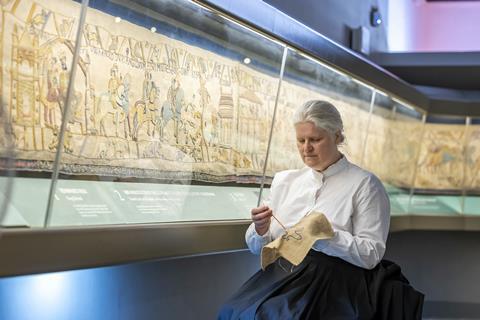
Matthew Williams, Reading Museum manager, said: “Reading’s own medieval history provided the perfect reason for the town to first acquire and exhibit Britain’s version of the Bayeux Tapestry back in the late 19th century.
“Now, with the tapestry’s own 140th anniversary coinciding with the imminent opening of the British Museum Bayeux Tapestry exhibition, we are delighted to see the renewed interest in this remarkable work of art.”
The Bayeux Tapestry
The original medieval artwork dates back to the 11th century and depicts the events of the 1066 Battle of Hastings. This battle was the last time England was invaded and marks the starting point of the country’s modern monarchy.
The Bayeux Tapestry is the only surviving pictorial account from the time of the events, and much of its origins are debated to this day, including where it was made and who was responsible for its creation.
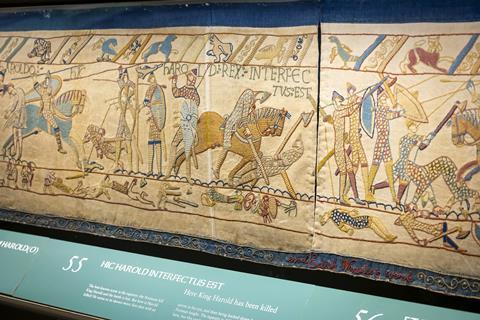
It has recently been transported to the British Museum where it will be displayed in England for the first time in over 1,000 years from 10th September to 11th July 2027 (tickets for 2026 have sold out; dates in 2027 will go on sale later this year).
Britain’s Bayeux Tapestry is widely regarded as an incredibly accurate replica of the original, except for one part - a naked man has been given underwear in the copy, based on an alteration made to the reference photograph in the V&A Museum for modesty.
Group visits at Reading Museum
Britain’s Bayeux Tapestry is free to visit at the museum from Tuesday to Saturday. Special one-hour guided tours of the tapestry are offered on select days for groups of up to 20. Groups can also book tours of Reading Abbey Quarter, which explores the heart of medieval Reading and highlights key features such as the Abbey Ruins and the Hospitium.
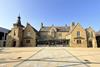
Reading Museum is conveniently located a short walk from Reading train station and bus stops, and there’s a coach drop off area opposite the museum.
Find out more about visits to Reading Museum at: readingmuseum.org.uk/your-visit/group-visits.