




Oxford University Museum of Natural History has completed its biggest redisplay project in its 165-year history, now with over 3,000 objects installed including three Oxfordshire dinosaurs.
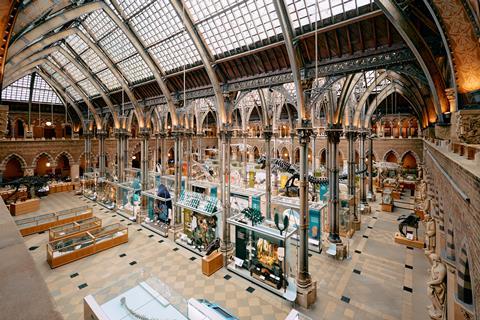
The museum has announced the completion of its largest redisplay project to date, marking the final phase of ‘Life, as we know it’ - an eight-year programme to transform the presentation of the Museum’s collections to visitors.
The ‘Life, as we know it’ project has seen the installation of 48 new displays in 24 state-of-the-art showcases themed around Biodiversity, Ecosystems, Evolution, and Earth. Thousands of specimens have been moved and conserved in order to stage them in a new design within the main court and Victorian building.
Dr Gavin Svenson, director of the Museum of Natural History, said: “‘Life, as we know it’ has been a long-term effort to rethink how we present the natural world to our visitors, and it is a pleasure to see that vision now fully realised.
“The new displays bring together thousands of specimens to tell some of the most important stories in science, from the history of life on Earth to the extraordinary diversity of the natural world today. We hope they will inspire curiosity, encourage discovery and help visitors of all ages see their place within the wider story of our planet.”
Oxfordshire’s prehistoric story
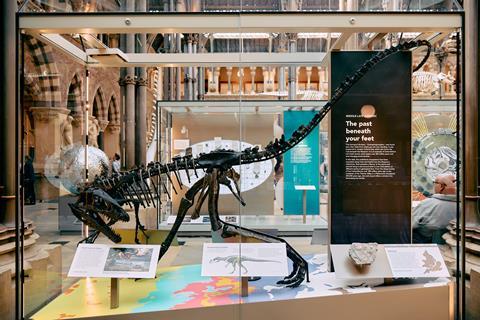
Forming part of the new prehistoric ecosystems display will be the fossilised remains of Megalosaurus, the first dinosaur ever to be named, which was found in an Oxfordshire quarry in the late 18th century.
Alongside Megalosaurus will sit a related genus, Eustreptospondylus, a predatory dinosaur discovered in Summertown, Oxford, in 1870. This will be exhibited for the first time as a fully articulated skeleton, using a combination of original fossil material, digital modelling and 3D printing, created in collaboration with the University of Chicago.
A third Oxfordshire dinosaur, Cumnoria, named after its discovery in Cumnor in 1879, is displayed sinking through the ocean to its final resting place in a showcase on fossilisation.
In 2024, a ‘dinosaur highway’ was excavated at a farm in Ardley, Oxfordshire by experts from the museum, revealing several different fossilised dinosaur footprints during the dig, including the distinctive three-toed claws of Megalosaurus.
A 60-metre-long sequence of Megalosaurus footprints cast from fossilised prints can also be seen crossing the lawn in front of the museum.
What else is on display?
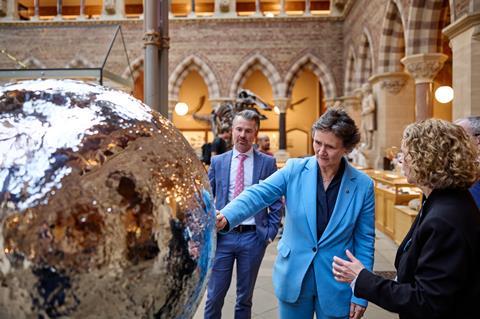
The new exhibits trace the history of the planet and the connection between life and Earth. Group visitors will now be able to have a tactile experience at the museum through touchable mineral specimens, as well as a replica of the Moon by artist Luke Jerram. The installation, called Mirror Moon, features a one-metre polished steel reconstruction of the Moon’s surface, created using topographic data from NASA, allowing visitors to feel every crater, valley and mountain.
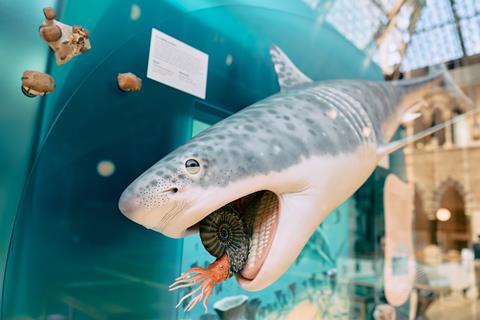
Visitors will also get to see what life was like underwater millions of years ago with the new interactive experience, Prehistoric Diver. From a virtual submarine, visitors can explore ancient ocean ecosystems from the Jurassic era and as far back as the Cambrian period (500 million years ago).
Professor Irene Tracey CBE, FRS, FMedSci, vice-chancellor of the University of Oxford, said: “Last year alone, more than 877,000 people came to the Museum of Natural History, making it one of the most visited university museums in the world.
“The completion of ‘Life, as we know it’ is a remarkable achievement that brings together cutting-edge science, outstanding collections and public engagement, helping new generations of visitors explore the history of our planet and the extraordinary diversity of life upon it.”
Group visits at the museum
Oxford University Museum of Natural History is free to visit and welcomes groups of up to 55 people.
Groups of ten or more need to book in advance; the museum is free to visit but there is an administration fee for group bookings.
Find out more about group visits at: oumnh.ox.ac.uk/group-and-school-bookings.