




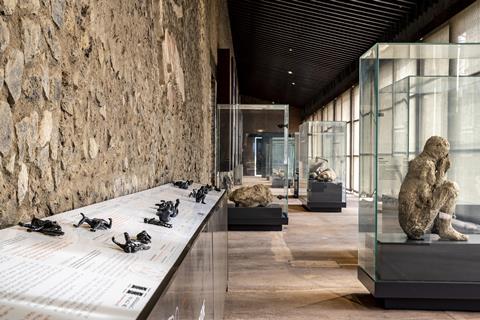
A powerful new permanent exhibition at the iconic Pompeii in Italy displays 22 incredible plaster casts of victims from the catastrophic 79AD eruption of Mount Vesuvius and recounts the moment-by-moment story of the disaster for the first time.
The eruption killed an estimated 2,000 people and made the ancient Vesuvian city a unique historical monument, which can be found around 15 miles from the city of Naples.
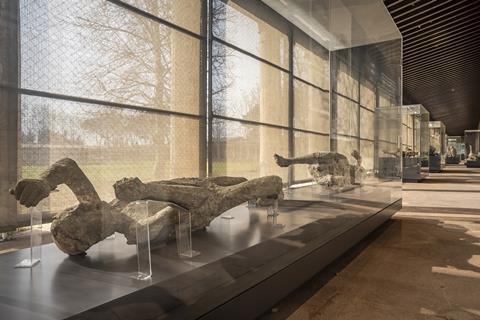
The casts capture the precise position each resident of the city died with reproductions created by pouring liquid plaster into the voids left by the bodies in the hardened ash.
The 22 casts were chosen among the best preserved remains of the more than 1,000 found during excavations. The victims were found across the city, from the inner areas to the gates and roads leading out of the town, many trying to flee to safety.
One of them is a man who was sitting with his knees tucked under his chin and his hands over his face, likely covering his mouth with his cloak.
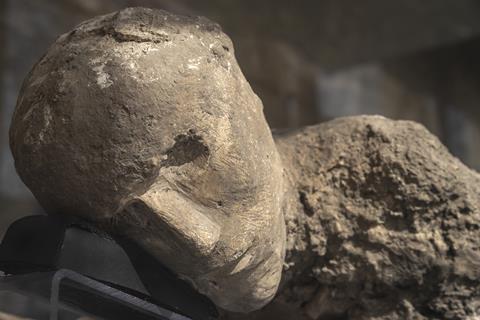
Another is a woman, found in 1976, who was lying on her side near one of the city gates surrounded by rings, coins and a small statue of the god Isis. One had plant material covering her legs, which experts have said she could have been trying to climb a tree in order to escape the tragedy.
Minister of Culture, Alessandro Giuli said: “It’s a courageous exhibition because it’s also extremely contemporary. Representing death isn’t easy, nor is it easy to showcase the naked casts of bodies engulfed by ash, volcanic fragments, and lava. You have to know how to do it and how to tell it with a scientific approach that’s also empathetic toward the pain. And the mission was successful.”
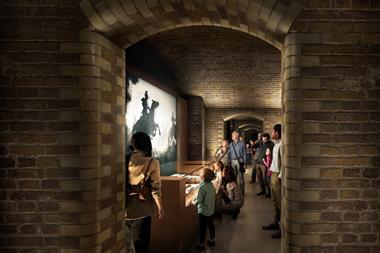
Inside the Palestra Grande exhibition space
Open to visitors in the Palestra Grande of the excavations, the exhibition explores the origins and history of the eruption as well as the technique of making casts.
A volcanology section features a new video about the eruption and the reconstruction of a four-metre-high column of ash and lapilli, the eruptive material that completely buried the city of Pompeii.
Part of the exhibition is dedicated to animals and plants, with a collection of preserved organic remains that illustrate the relationship between humanity and natural resources. The North Arm houses the section dedicated to human remains.
Honouring the victims of Pompeii
Gabriel Zuchtriegel, director general of the Pompeii Archaeological Park, said: “Personally, I consider this the greatest museological challenge we have ever faced, and I thank the entire team.
“The casts of the victims are not artefacts, they are not statues, and they are not works of art, neither ancient nor contemporary. To express what they are, perhaps a phrase once uttered by a colleague on an excavation where we discovered a victim is enough: this is us.
“We can see our fragility, our humanity, and our vulnerability in the casts of children, women, and men who died in 79 AD: therefore, from a respectful encounter with these testimonies, which we have tried to make possible with the new exhibition, we can to convey a profound message: life is precarious, precious, life is beautiful.”
Group visits to Pompeii
Up to 35 people are permitted in a group to pre-book tickets to visit and various group holidays to the Amalfi Coast in Italy include a visit to the iconic site.
When visiting Pompeii you can wander ancient streets, explore remarkably preserved homes, bathhouses, and temples, and see vivid frescoes and mosaics. Highlights like the Forum, the amphitheatre, and plaster casts of residents offer a powerful sense of the city’s history and human stories.
For more information about group bookings, visit pompeiisites.org/per-i-gruppi.
To find out more about the sites, and the new exhibition, visit pompeiisites.org